|
Indian enterprises are done with AI pilots — now it’s time to operationalise. Discover how IT leaders are deploying Agentic AI, Microsoft Copilot & Zero Trust to drive real business ROI in 2026.
|
If your organisation ran a Microsoft Copilot pilot in 2024—or experimented with ChatGPT integrations in 2025—you are not alone. Almost every Indian enterprise we speak with has done the POC. The harder question in 2026 is: how do you move AI from the boardroom slide deck into actual business operations?
This is no longer a technology question. It is a governance, infrastructure, and change-management question. And for CIOs, CTOs, and IT heads navigating India’s rapidly evolving digital landscape—balancing DPDP Act compliance, cybersecurity mandates from CERT-In, and board pressure to show AI ROI—the stakes have never been higher.
At Cloud 9 Infosystems, a Microsoft Azure Expert MSP with 16+ years of enterprise IT experience, we help Indian organisations bridge exactly this gap. Here is our 2026 roadmap for IT leaders who are ready to stop experimenting and start operating.
1. Stop 'Buying' AI — Start 'Hiring' Digital Workers
What Is Agentic AI and Why Does It Matter for Indian Enterprises?
The first wave of AI gave us chatbots and summarisation tools. The 2026 wave is different: it is about Agentic AI—autonomous AI systems that execute multi-step business processes without human hand-holding.
Think of it this way: a Copilot assistant tells your IT helpdesk agent what to do. An Agentic AI actually does it—triaging service tickets, onboarding new employees in SAP, flagging anomalies in your ERP, and filing compliance reports—all without a human clicking ‘approve’ at each step.
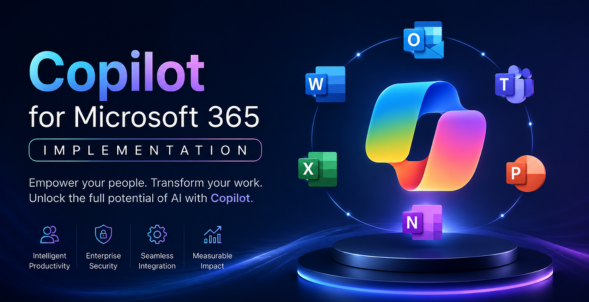
Microsoft’s Azure AI Foundry and Microsoft 365 Copilot are the platforms that power these agents. For Indian IT leaders, this means:
- Your IT helpdesk can deflect 40–60% of L1 tickets automatically
- HR onboarding workflows that take days can be compressed to hours
- Finance teams can automate reconciliation, audit trail generation, and GST-compliance checks
- Security teams get an AI co-analyst that investigates incidents in real time
|
C9 Recommended Action
|
|
✔ Identify one high-volume, rule-based operational workflow (e.g., IT Service Desk L1 or vendor invoice processing)
|
|
✔ Build an Agentic AI POC on Azure AI Foundry within a 6-week sprint
|
|
✔ Define KPIs before you start: ticket deflection rate, cost per resolution, MTTR
|
2. Identity Is Your New Firewall — Especially in India's Threat Landscape
India recorded over 1.3 billion cyberattacks in 2023 according to CERT-In data—and that number is growing. The traditional security perimeter (your corporate firewall) no longer exists in a world of hybrid work, SaaS applications, and multi-cloud architectures.
The new perimeter is Identity. Every user login, every API call, every device that touches your systems is a potential attack vector. This is the foundation of the Zero Trust security model that India’s most security-conscious enterprises are adopting.
What to Implement in 2026
- Microsoft Entra ID with phishing-resistant MFA (FIDO2/Passkeys)—move away from OTP-based authentication which is vulnerable to SIM-swap attacks prevalent in India
- Risk-based Conditional Access: block or step-up challenge logins from unusual locations or devices
- Privileged Identity Management (PIM): enforce Just-In-Time (JIT) access for admin accounts—no standing privileges
- Post-Identity Review: audit every service account, shared credential, and privileged user in your AD
⚠️ DPDP Act Note: India’s Digital Personal Data Protection Act 2023 mandates strict controls over access to personal data. Entra ID’s risk-based access policies and audit logs directly support DPDP compliance requirements for data fiduciaries.
3. Your AI Strategy Is Only as Good as Your Data Strategy
Here is the uncomfortable truth that many AI vendors will not tell you: most Indian enterprises are not ready to deploy enterprise-wide AI—because their data is not ready.
We regularly see: unclassified sensitive data sitting in shared drives, PII scattered across unstructured SharePoint folders, dark data (data that exists but is never used or governed), and no data lineage or retention policies.
If you deploy an AI agent on top of this, you are not creating efficiency—you are creating a compliance and data-leak disaster.
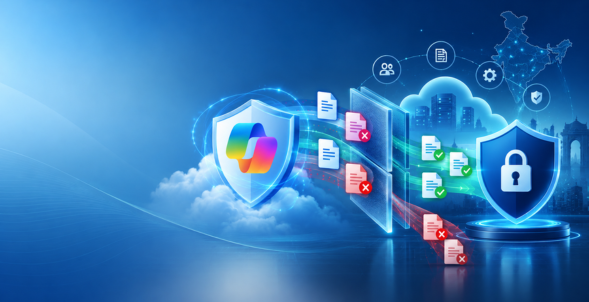
The Microsoft Purview-First Approach
Before any AI rollout, Cloud 9 recommends a Data Readiness Assessment using Microsoft Purview. This involves:
- Classifying all enterprise data by sensitivity (Confidential, Internal, Public)
- Identifying and cleaning ‘dark data’—redundant, obsolete, and trivial (ROT) data
- Setting Data Loss Prevention (DLP) policies to prevent AI agents from surfacing restricted content
- Establishing data lineage so you know exactly what data trained or informed each AI output
|
C9 Standard
|
|
✔ Run an AI Readiness Assessment (data classification + governance audit) before any enterprise AI deployment
|
|
✔ Target: 100% classification of Tier-1 data assets before Copilot goes live organisation-wide
|
4. Modernise Your SOC: AI-Native Security Operations for India
Cyber threats now move faster than human analysts can respond. A ransomware attack can encrypt your entire file server in under 10 minutes. Manual SOC investigation simply cannot keep pace.
The answer is an AI-Native Security Operations Centre (SOC) powered by Microsoft Sentinel (cloud-native SIEM) and Microsoft Defender XDR (extended detection and response).
Why This Is Urgent for Indian Enterprises
- CERT-In’s 2023 directive mandates incident reporting within 6 hours—AI-assisted SOCs dramatically reduce detection-to-reporting time
- The BFSI, healthcare, and government sectors face increasingly targeted attacks from nation-state actors
- IT and ITeS companies handling global client data face contractual SLA obligations around breach notification
An AI-native SOC doesn’t eliminate your security analysts—it makes them 10x more effective by automating alert triage, correlating signals across identity, endpoints, email, and cloud, and suggesting response playbooks in plain English.
5. Build Domain-Specific AI: Stop Using Generic Models for Enterprise Problems
General-purpose AI (GPT-4o, Gemini, Claude) is impressive—but it doesn’t know your internal policies, your client contracts, your product catalogue, or your regulatory environment.
In 2026, the competitive advantage goes to enterprises that build domain-specific AI trained or grounded on their own proprietary data using Azure OpenAI Service with Retrieval-Augmented Generation (RAG).
Examples relevant to Indian enterprises:
- A manufacturing company’s AI that understands their specific BOM structures and vendor contracts
- A pharma company’s regulatory assistant trained on CDSCO guidelines and internal SOPs
- A bank’s customer service AI that knows RBI compliance rules and internal product T&Cs
- An IT services firm’s bid-writing AI trained on past proposals and win-loss data
6. Secure Your AI-Powered Development Pipeline
GitHub Copilot is already being used by development teams across India’s IT and product companies. It is genuinely transformative—developers report 30–50% productivity gains. But it introduces new risks that your security team may not have planned for:
- AI-generated code can introduce subtle vulnerabilities (insecure dependencies, hardcoded secrets, OWASP Top 10 issues)
- Developers may inadvertently use Copilot suggestions that include copyrighted third-party code
- Without guardrails, sensitive business logic can be exposed through AI code suggestions
The C9 Secure Development Standard
- All AI-generated code must pass the same automated SAST/DAST scanning as human-written code—no exceptions
- Integrate GitHub Advanced Security for secret scanning and dependency review
- Establish an AI Code Policy: what data can developers reference in Copilot prompts?
- Use GitHub Copilot for Business (not individual) to ensure your code stays within your enterprise tenant
7. Data Sovereignty and Compliance-First Cloud for Indian Enterprises
With the DPDP Act now in force and global clients increasingly scrutinising data residency, where your data lives is as important as how it is protected.
Azure’s India regions (Central India – Pune, South India – Chennai, West India – Mumbai) give Indian enterprises full data residency within Indian borders while still accessing global Azure services. This is critical for:
- BFSI companies under RBI data localisation guidelines
- Healthcare providers under ABDM data governance norms
- Government and PSU entities under MeitY cloud policy
- Enterprises handling EU/US client data with cross-border transfer restrictions
Why Indian IT Leaders Choose Cloud 9 Infosystems
Navigating this landscape requires more than a Microsoft reseller. It requires a partner who has done this before, at scale, in Indian enterprise environments.
Cloud 9 Infosystems brings:
- 16+ years of Microsoft-focused enterprise IT expertise
- Elite Azure Expert MSP designation — one of the most rigorous Microsoft partner certifications globally
- Deep experience across BFSI, manufacturing, IT/ITeS, healthcare, and government sectors in India
- Pre-built accelerators for AI Readiness Assessment, Zero Trust deployment, and Copilot enablement
Navigating this landscape requires more than a Microsoft reseller. It requires a partner who has done this before, at scale, in Indian enterprise environments.
Cloud 9 Infosystems brings:
- 16+ years of Microsoft-focused enterprise IT expertise
- Elite Azure Expert MSP designation — one of the most rigorous Microsoft partner certifications globally
- Deep experience across BFSI, manufacturing, IT/ITeS, healthcare, and government sectors in India
- Pre-built accelerators for AI Readiness Assessment, Zero Trust deployment, and Copilot enablement
Ready to Move from AI Experimentation to AI Operations?
Further Reading & References
About Cloud 9 Infosystems: Cloud 9 Infosystems is a Microsoft Azure Expert MSP headquartered in Chicago USA & Operations in Mumbai India, helping enterprises across BFSI, manufacturing, and IT sectors build secure, AI-ready cloud infrastructure. With 16+ years of experience and a team of certified Microsoft architects, we specialise in AI readiness, Zero Trust security, cloud modernisation, and Copilot enablement. www.cloud9infosystems.in