

It is 2 a.m. and production is down. Your most experienced engineers are jumping between five dashboards, exporting logs, and comparing timestamps by hand just to find where the problem started. Every minute of that scramble costs money, customer trust, and sleep.
This is the exact moment agentic observability is built for. As cloud systems grow more autonomous and interconnected, no single team can hold the full picture anymore, and agentic observability uses AI agents to close that gap, turning scattered telemetry into a clear answer in real time.
For the operations teams who keep production running, this is a genuine turning point. Here is what it is, why traditional monitoring is buckling under modern complexity, and how to adopt it on Azure without giving up control.
WHAT YOU WILL LEARN
THE SHORT VERSION
Agentic observability is an approach where AI agents continuously analyze your operational signals, reason about what they mean, and surface insight before your team even starts investigating.
Traditional observability gives you dashboards full of data. Agentic observability adds an AIOps layer on top that interprets that data for you. Instead of asking engineers to piece together what happened across a dozen tools, an agent correlates the signals and explains the situation in plain language.
The goal is not to remove humans. It is to get operators from “something is wrong” to “here is the likely cause” far faster, which is the difference between a five-minute blip and a five-hour outage. If agents are new territory for your team, our agentic AI readiness checklist for 2026 is a useful starting point.
Modern systems no longer fail in neat, isolated ways. They fail through interactions across services, dependencies, and environments that change constantly.
As applications, models, APIs, and infrastructure become more interconnected, their end-to-end behaviour gets harder to understand. Telemetry now streams from every layer: health, configuration, cost, performance, and security.
The result is a familiar pain. Alert volume climbs, context is scattered across tools, and your SRE and incident response teams spend the critical early minutes just assembling the picture instead of fixing the problem.
When the pace of change outruns any single team’s ability to hold context, monitoring alone is no longer enough.
This is the gap agentic observability is built to close. It is also tied to cost: the same telemetry that drives reliability decisions increasingly drives spend decisions, which is why we pair it with our guide to Microsoft AI cost management.
Microsoft has made the Azure Copilot Observability Agent generally available. Built on Azure Monitor, it correlates signals across agents, applications, infrastructure, and services to provide the context teams need to operate.
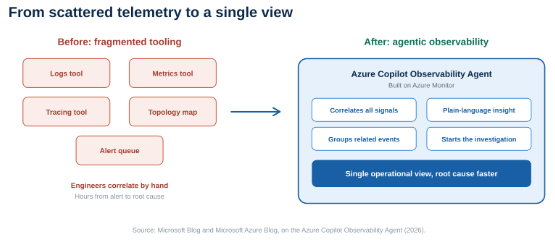
In practice, it connects logs, metrics, traces, topology, and operational context across environments. It establishes a baseline of normal behaviour, then watches for patterns. When an issue begins to emerge, it can start the investigation and provide context before your team opens a single dashboard.
That changes incident response in two concrete ways. Issues surface earlier, and related signals arrive already grouped, which cuts the noise engineers normally wade through and speeds root cause analysis.
The reported impact is meaningful. Microsoft describes a customer that turned logs, metrics, and traces into plain-language insight, received remediation recommendations almost immediately rather than after hours or days, and reclaimed an estimated 250 engineering hours each month to redirect toward new work.
See where agentic observability fits in your Azure environment.
In a free 30-minute consultation, Cloud 9 Infosystems will review your current monitoring, pinpoint where the Observability Agent can cut your incident response time and outline the guardrails to adopt it safely.
Observability is only the first step. Microsoft frames it as part of a broader shift to agentic cloud operations, where insight connects directly to action.
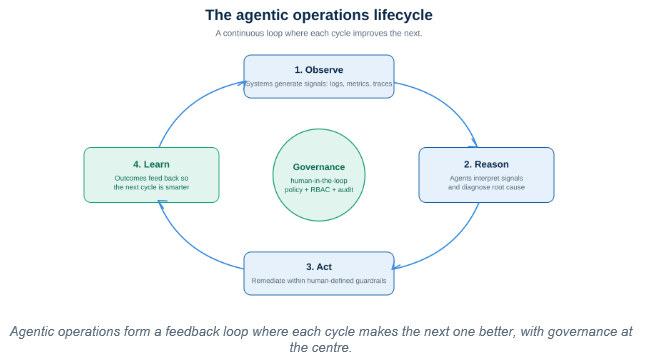
In this model, the work forms a lifecycle. Systems generate signals, agents interpret those signals, action is taken, and the outcomes feed back in so the next cycle is smarter. Over time, this loop increases resilience and efficiency.
It also spans more than detection. A complete approach connects observability and diagnosis to optimization and remediation, so insight and action stay tightly linked rather than living in separate tools and teams. This is the same operating model behind our work on agentic AI digital workers for enterprises.
This is a real industry shift, not a niche experiment. Microsoft cites research finding that the majority of organizations are already deploying agentic AI in production, which is how quickly this is becoming the default way to run cloud environments.
Handing agents a role in operations only works if every action stays controlled. This is the part IT leaders should weigh most carefully, and it is where Microsoft has put real emphasis.
In Azure, agent-initiated actions are designed to honour existing policy, security, and role-based access controls. Actions are meant to be reviewable, traceable, and auditable, so human oversight stays central rather than being removed.
The principle is simple: autonomy and safety should advance together. Agents accelerate the work, but humans define the boundaries and approve the decisions that matter. We go deeper on this in AI agents are here: but are they working for you or against you? and in our broader approach to secure enterprise AI in 2026.
You do not need to re-platform to get started. A sensible path looks like this:
This is exactly the kind of work an experienced Azure partner can stand up quickly. Cloud 9 Infosystems has spent 16-plus years helping US enterprises run and modernize the Microsoft cloud across healthcare, financial services, and enterprise IT, from cloud and AI solutions to security monitoring with Microsoft Sentinel.
Agentic observability is not about replacing your operations team. It is about giving them context at machine speed, so they spend less time assembling the picture and more time making good decisions.
The organizations that adopt it deliberately, with clean telemetry and strong governance, will resolve incidents faster and run leaner. The ones that wait will keep paying the tax of fragmented tooling and manual correlation.
Microsoft has made the capability generally available. The advantage now goes to the teams that adopt it with discipline.
Agentic observability is an approach to monitoring where AI agents continuously analyze operational signals such as logs, metrics, traces, and topology, reason about what they mean, and surface insight before engineers begin investigating. It builds on traditional observability by interpreting the data, not just displaying it.
It is a Microsoft capability, now generally available and built on Azure Monitor, that correlates signals across agents, applications, infrastructure, and services. It establishes baseline behaviour, detects emerging issues, begins investigation, and provides context to help teams move from detection to root cause faster.
Traditional monitoring shows you dashboards and alerts that engineers must interpret and correlate manually. Agentic observability adds an AIOps layer that reasons across those signals in real time, groups related events to reduce noise, and explains the likely cause, shortening mean time to resolution.
It can be, when governance comes first. In Azure, agent actions are designed to honour existing policy, security, and role-based access controls, and to remain reviewable, traceable, and auditable, with humans retaining oversight of high-impact decisions.
Agentic cloud operations is a broader model in which AI agents, guided by human intent, continuously observe, reason, and assist with action across the cloud lifecycle, from observability and diagnosis to optimization and remediation. Observability is the foundation that gives those agents the context they need.
Begin by ensuring consistent telemetry through Azure Monitor, choose one high-value workload to prove value, set governance and access controls before granting autonomy, and keep humans in the loop for high-impact actions. A readiness assessment with a Microsoft partner can map the right starting point for your environment.
Microsoft just made agentic observability generally available, and the teams that adopt it first will resolve incidents faster and run leaner. Cloud 9 Infosystems will assess your monitoring setup, design the governance, and help you put agentic cloud operations to work without losing control.

For over 16+ years, Cloud 9 Infosystems has maintained a strong and enduring partnership with Microsoft—delivering enterprise-grade solutions across cloud, AI, and data platforms. As a Microsoft Designated Solutions Partner, we have consistently enabled organizations to modernize their infrastructure, enhance operational efficiency, and accelerate innovation. This collaboration reflects our shared commitment to driving digital transformation with integrity, expertise, and forward-thinking solutions. As we look to the future, Cloud 9 remains dedicated to empowering businesses through trusted technology and measurable outcomes.
Error: Contact form not found.